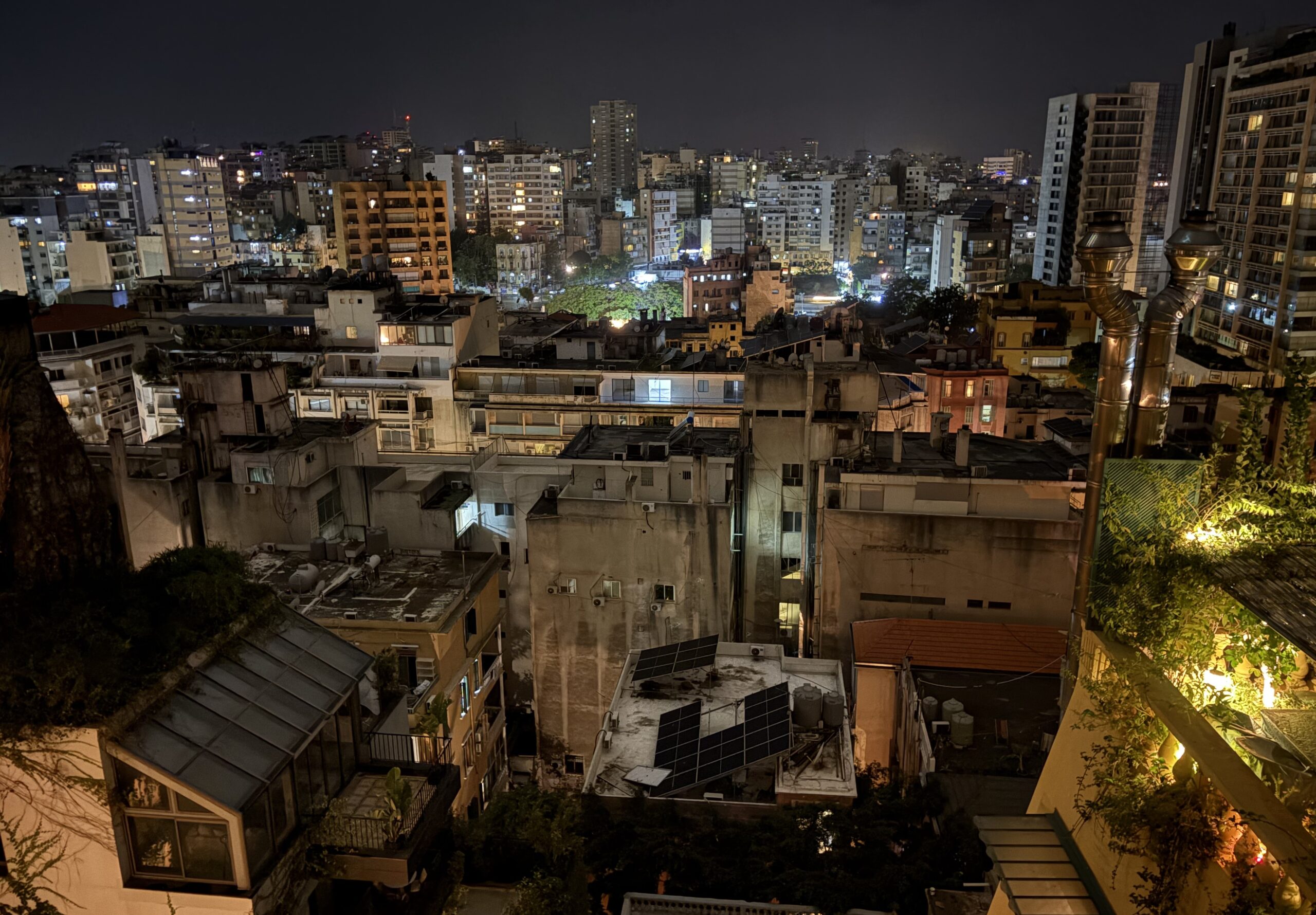
In Beirut, the power cut is no longer an event. It is a timetable. The lights go out, a diesel engine coughs into life somewhere down the street, and a man with a ledger decides what you owe him this month – most of the times around 500 dollars for a regular flat – for the privilege of continuing your evening.
That last part is the story. The headline numbers about Lebanon’s electricity crisis are famous: a state utility that delivers a few hours of electricity a day, an industry of private generators filling the gap. The less-told part is the money: Lebanese households are paying for electricity twice – once through the taxes that kept a failing utility afloat for decades, and again through a monthly subscription to the neighbourhood generator. Now that Qatar has put a very large offer on the table will it change who pays?
What a month of light costs
Let’s start with the arithmetic, because it is brutal. In August the Energy Ministry set the official generator tariff at 48,241 Lebanese pounds per kilowatt-hour in cities. That is nearly $0.54, according to L’Orient Today, and almost 60% above where it stood in February. On top comes a fixed monthly fee: 385,000 pounds for a 5-ampere connection, 685,000 for 10.
One Lebanese analysis ran the numbers for a 10-ampere household. At 300 kWh a month, the bill comes to about $169. At 500 kWh, about $277. At 700 kWh, more than $384. For a family living on $1,500 a month, the middle case swallows over 18% of income before a single dollar goes to the state utility, rent or food.
You will hear that some households pay $500 a month. I treated that as a rumour to test, not a fact to repeat. At the official tariff, $500 implies roughly 900 kWh, which is my own back-of-envelope figure. That is a large, air-conditioned home, or a household paying surcharges the tariff does not allow. It is a real bill for some people. It is not the typical one, and I found no representative household survey that says otherwise.
The same caution applies to the claim that Beirut gets “two hours a day” of state power. Ministry figures cited by a Lebanese outlet put supply at 7 to 9 hours in February, a rare good stretch. By August it had slumped again after a delayed fuel shipment, L’Orient Today reported. Reuters now says “a few hours.” Two is believable in some districts on some days, albeit it may not be true as a standing citywide fact.
Leaking bucket under a broken tap
It is tempting to say Lebanon has an electricity problem. It has at least five, and they feed on each other.
1/ The money. EDL, the state utility, lost $1.8 billion in 2018, because it sold power for less than it cost to make. This year brought a different blow. Diesel climbed to nearly $1,500 a tonne, against EDL’s $680 budget. A normal utility has three shock absorbers: a tariff that adjusts quickly, fuel hedges, or a strong balance sheet. The EDL has none of them.
2/ The leak. In 2023, the World Bank put total losses at roughly 40% of the electricity fed into the grid. About 4% vanished in transmission and 9% in technical distribution losses. The remaining 25% were commercial losses: theft, unmetered connections, bills never sent or never paid. This is equivalent to placing a bucket with a hole in it under a tap that is barely running. Adding a bigger tap gets you wetter floors, not fuller buckets.
3/ The unpaid bill. Energy Minister Joe Saddi said the state and its own institutions owed EDL about $250 million as of December 31. It is a strange kind of reform that asks households to pay on time while the government does not.
4/ The fuel lifeline. Since 2021, Iraq has supplied heavy fuel oil that Lebanese plants cannot burn. Lebanon swaps it, through a third-party company, for fuel the plants can use, and Iraq is repaid in services such as healthcare for its citizens. It works, but it lives on renewals, some of them lasting only six months. In 2025 a late shipment forced EDL to ration supply.
5/ The temporary fix that wasn’t. Lebanon’s Turkish power barges are the cautionary tale. Then-energy minister Gebran Bassil described them as a three-year stopgap while conventional plants were rehabilitated. The contract was later extended to nine years in total. It ended in payment disputes, with Lebanon’s financial prosecutor asking for the vessels to be seized. A L’Orient Today investigation report called the original tender opaque.
The lesson is not that emergency power is always wrong. It is that in Lebanon, “temporary” has a habit of becoming permanent when the real reforms stall.
The almighty Mafia
When the state stopped delivering, the neighbourhood generator stepped in, and a shadow utility was born. It is not entirely lawless. The ministry publishes a reference tariff each month, tied to the diesel price, and municipalities add their own rules. Case in point, in Sidon, the municipality’s regulation committee told generator owners to supply at least 12 hours a day in its September 2026 notice, stating that the tariff of 52,840 pounds per kWh was applicable only on this condition. If an owner supplied more than 17 hours, the price rose to 61,000 pounds per kWh. On 8 October, 2026, ground realities forced Prime Minister Nawaf Salam to promise that generator owners and traders would not be allowed illegitimate profits.
When a published price cannot be enforced price, and when most subscribers cannot shop around, the situation becomes dire – the consumer goes to whoever owns the generator on their street. The authorities themselves distinguish between increases that diesel justifies and charges with no regulatory basis, one Lebanese analysis notes, and they tightened inspections in early September. That distinction matters, because it is where honest operators and bad ones separate.
Many Lebanese call this sector a mafia with consumers alleging cartel-like behaviour in fuel imports; there are also reports of US sanctions in 2023 against two businessmen over a tainted-fuel scandal. None of this resulted in a court ruling or regulatory finding of collusion among generator operators. The widespread corruption has taken root deeply, resulting in widespread public anger since they are the ones who are having to bear its cost.
As per a 2023 IMF report, generator power cost 45 to 50 cents a kilowatt-hour in Lebanon, against a world average around 16. The generator mafia is able to retain their grip since their service is the only thing that works. Any reform that switches them off before the grid improves leaves families in the dark.
Qatar’s offer: big, real and not yet a deal
On 19 October, Reuters reported on a document describing two Qatari-built power plants and a 20-year LNG supply deal. Its title is the National Integrated Energy Investment Program, and it was drafted with input from both governments. Here are its salient features:
Two plants of 825 MW each, at Deir Ammar in the north and Zahrani in the south: 1,650 MW in all.
A 20-year gas contract with QatarEnergy, fed by a floating storage and regasification unit (FSRU) rated at 3.5 million cubic metres a day, plus the Arab Gas Pipeline through Syria at 4.5 million.
Extras: 800 MW of solar, 440 MW of wind and electricity imports from Syria.
Financing: private or project finance with no upfront public spending, but payment obligations and guarantees “remain subject to negotiation,” the document says.
It is important to note this document is still in the draft stage. As per a source familiar with the matter at hand, the document still needs to be approved from both governments and may change. There is no early signs of any power-purchase agreement, disclosed financing and date on which construction will commence.
Fine print between speeches
The politics around the Qatari offer are warmer than the paperwork. On 16 October, Prime minister Nawaf Salam said Qatar “will finance, implement and operate” the project with no prior cost to the Lebanese Treasury. Qatar’s prime minister added that QatarEnergy and TotalEnergies would jointly develop a solar plant as a first step.
But here is what the document actually states: payment obligations and guarantees are still to be negotiated. That is the whole ballgame. “No upfront cost” is not “no cost”. Project finance gets repaid through what the buyer pays for electricity and gas, and in Lebanon the buyer is EDL, a utility that cannot reliably collect its own bills. If the state guarantees those payments, the risk lands on taxpayers, the same people already funding generators.
Three questions will decide whether households gain anything.
What will the gas cost? No price formula has been published. If it tracks oil, Lebanon could meet the same kind of shock that has just hit EDL’s diesel budget. A 20-year contract might also carry take-or-pay terms, meaning Lebanon pays for gas whether or not it can use it.
Can the gas physically arrive? Two 825 MW plants at full load would burn about 6 to 7 million cubic metres a day. The cited capacity is 8 million, but only if both the FSRU and the Syrian pipeline work. The pipeline needs repairs.
Will anyone pay for the power? More megawatts on a grid that loses 40% of its energy means a bigger bill nobody collects.
On the test that matters, it is hard to predict whether it will lower household costs, lengthen electricity supply or retire generators. None of that can be shown from what documents that are publicly available.
What is still missing are: the electricity tariff, the gas price formula, the guarantee structure, who owns and operates the plants, and who signs for Lebanon.
Solar Energy, the true-false solution
Solar has quietly done what the state could not. Off-grid capacity reached about 1,000 MW by the end of 2023, and it has cut generator bills for those who could afford the panels and batteries. That is also the catch. It has created a two-speed country, where families with capital escape the generator and families without it keep buying the most expensive kilowatt-hour in the system.
The contrast is stark. Utility-scale solar contracts have been signed at roughly 6 cents a kilowatt-hour, against generator power at 54 cents. But cheap generation is not the same as a cheap bill. Transmission, losses, storage and collection all sit on top of the cost of the sun.
Gas is probably cheaper than diesel at the margin, if the price, the delivery chain and the plant efficiency all go right.
No single technology rescues Lebanon. Hospitals and factories need firm supply that solar power alone cannot guarantee.
Potential Outcomes
The good one. Approvals come fast. The FSRU is built and the pipeline repaired. Contracts are published and the buyer can pay. Losses fall, collections rise, solar and storage tenders close, and generator subscriptions shrink as grid hours grow. That future needs discipline inside EDL and a regulator that works. Plants alone will not deliver it.
The likely one. Some projects advance, most slowly. Solar and imports add partial supply, gas arrives late or in small volumes, and the Treasury quietly absorbs some guarantees. Generators stay essential. The bottlenecks are money, infrastructure and collection.
The bad one. The Qatari plan stalls at approval or at the payment terms. Fuel stays on short renewals, another oil shock lands, and EDL stays starved of cash. Households keep paying the generator, and the state takes on new liabilities.
We all know the reality of the Lebanese administration and decision-making processes, in a country that has unfortunately left the keys to the energy sector to mafias. After almost two years in power and many broken promises, the Lebanese government will have to show what it is capable of. Fingers crossed.